
Futurist series highlights consumerization of health care

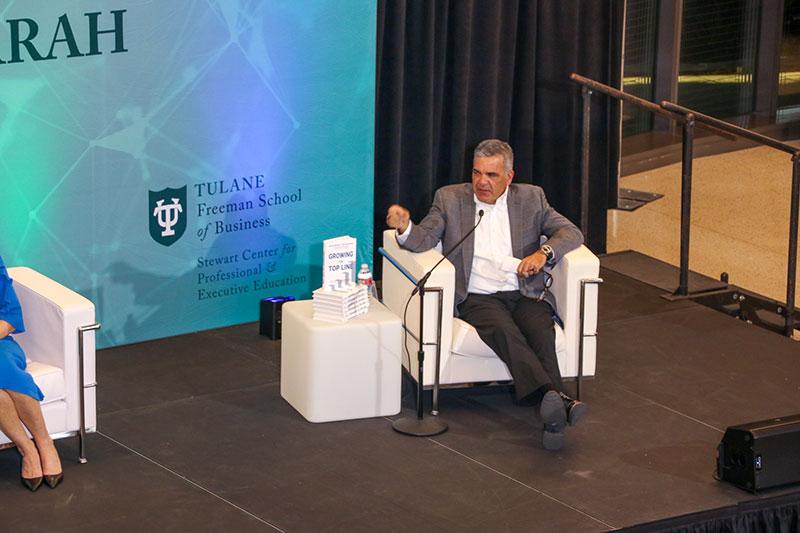
The impact of artificial intelligence, personalized medicine, the shift to home-based care and the consumerization of health care were central themes of the latest Freeman Futurist Series presentation, “Bioinnovation: The Future of Health Care.” The discussion, which took place in the Freeman School’s Marshall Family Commons on Jan. 22, brought together a panel of industry experts to explore how AI, advanced diagnostics and home-based care are reshaping the global health care landscape."
“If you think the health care system is designed around the patient,” said panelist Sheri Dodd, “you are sorely mistaken.”
But Dodd, chief executive officer of at-home therapy device company Tactile Medical, said emerging technologies such as wearables, biosensors and remote patient monitoring devices have the potential to bring about a more patient-centered system.
“The idea that you can provide therapy at home when it makes the most sense for the patient is great,” she said. “And when that therapy becomes smarter — when it starts to become personalized to where I am physically located, what my lifestyle choices are and what my symptom management needs are on a specific day versus a generic approach — that benefit becomes incredibly important to the patient.”
Joining Dodd on the panel were Paul Beresford, senior vice president of BioPharma Partnerships at PathAI, and Stacey Shulman, vice president and general manager of Health, Education and Consumer Industries at Intel. Moderating the discussion was Cliff Farrah, chief strategy officer for Corporate Strategy and Growth at Accenture and Executive-in-Residence at the Freeman School.
With AI’s capabilities doubling every six months, Shulman said the medical profession is likely to feel its effects sooner rather than later.
“I think it’s going to eliminate all those jobs where people are checking stuff, like radiology charts,” Shulman said. “Those types of things AI is going to fully automate, and the traditional radiologist position will start going away.”
Beresford, whose company uses AI to improve diagnostic accuracy, enhance lab efficiency and accelerate drug development, offered a more nuanced view. Rather than eliminating pathologists, Beresford sees AI as enabling them, dramatically enhancing their capacity.
“Pathologists today are overworked and overwhelmed,” he said. “There’s a tremendous uptick in the use of personalized medicine, so for efficiency, pathologists need to leverage AI at every step of the equation, from digitizing slides to prioritizing caseloads to using AI to help diagnose patients to using generative AI to actually write the pathology report. I personally see pathologists at the center of the workflow. I see them leveraging AI as a key part of their daily work.”
With a rapidly growing population of seniors, Farrah noted that the U.S. is projected to face a shortage of 500,000 assisted living beds in the next 10 years. Shulman suggested that one solution might be found by looking to the innovations of other industries.
“Airbnb expanded hotel rooms into the home; my hypothesis is that’s what has to happen in the health care system,” she said. “We have to expand hospital rooms into the home, and we have to do it in a way that the clinician feels comfortable with.”
But enhanced technologies in the home aren’t enough, Shulman said. There also needs to be infrastructure to support the delivery of care when a physician detects an issue remotely.
“[Providers need to] leverage an ecosystem that is like the Uber Eats gig worker of medical and have that meet the Airbnb for the hospital,” she said. “And I do think that we’re very close to that.”
The rise of physicians who don’t accept insurance and off-label drug use – the practice of prescribing drugs for different purposes than what they were approved for or what insurance companies will pay for — emerged as another central theme. Farrah argued that the advent of quantum computing will drive down the cost of genetic sequencing, making personalized medicine a reality for those with the resources to pay for it.
“But I feel like the reality of a secondary market that is aligned with economic health – the richer you are, the better your care is going to get over the next 10 years— is a real threat that we face as we think about going forward,” Farrah said.
Ultimately, Shulman said the consumerization of health care is likely to be a net positive for patients.
“It puts the patient into a consumer mindset, and then the demand starts shaping differently,” Shulman said. “If I’m paying you directly, I have a different level of expectation on your professionalism, your quality and the service I get. Right now, because they're not paying the doctor directly, patients don’t feel they have the right to demand a level of service and quality they would in every other aspect of their life. So I actually think it’s going to improve our health care system as expectations of quality and care and just bedside manner go up.”
The Freeman Futurist Series is presented by the Freeman School’s Stewart Center for Professional & Executive Education with support from the R.W. Freeman Distinguished Lecture Series Endowment Fund. The next presentation will take place on April 9 in the Marshall Family Commons and will focus on private equity.
Interested in advancing your education and/or career? Learn more about Freeman’s wide range of graduate and undergraduate programs. Find the right program for you.
Other Related Articles
- Futurist Series highlights AI’s impact on private equity
- Executive MBAs team up with peers from around the world for International Week
- ENFRA partners with Stewart Center to launch executive leadership program
- Freeman Futurist Series looks at AI, Robotics and Quantum
- Embracing Business Futurism: A Conversation with Cliff Farrah
- EMBA Marine rises through the ranks
- Freeman Futurist Series explores innovation, leadership and emerging technologies
- Freeman announces new administrative appointments
