
Executive MBAs team up with peers from around the world for International Week
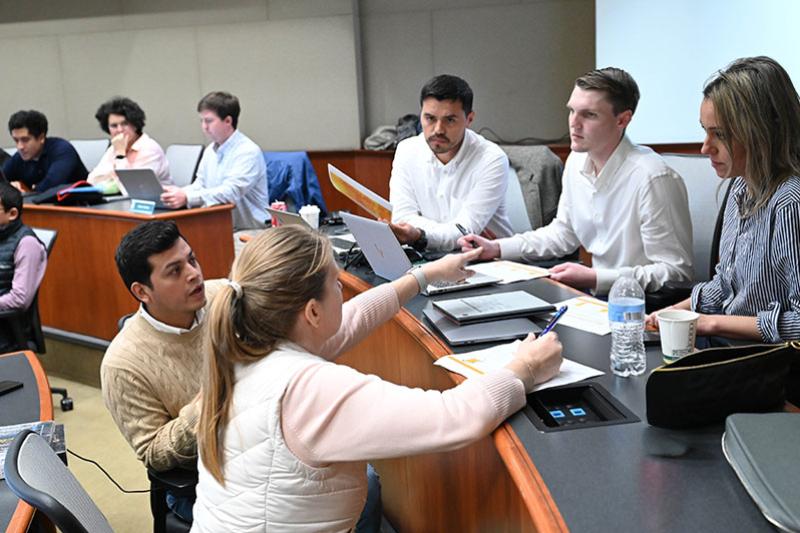
As commercial director with E.N. Bisso & Son, a New Orleans-based tugboat operator with operations in nine ports across the Southeast, Jean-Paul Richard (MBA ’26) spends a lot of time working with international clients.
“You need to know your audience,” says Richard, a Freeman School Executive MBA student. “When you sit down with someone to have a business meeting in New Orleans, for the first 20 minutes or so, you’re talking about family — ‘How’s everything going?’ In Chile, there might be a little talk, but you’re getting down to business quickly, whereas in Mexico, if you’re going to meet for an hour, it’s 50 minutes of family and personal life and the last 10 minutes, you talk business.”
Understanding the nuances of doing business internationally was the focus of a recent Freeman School program that brought students from the U.S., Latin America and Europe together for a week of classes, group projects, field trips and social activities.
Richard was one of more than 50 executives who took part in EMBA International Week, an annual event that connects students in the Freeman School's Executive MBA program with students from Freeman's international partner institutions. This year’s program, which took place Jan. 5-11, featured students from Centrum PUCP Business School in Lima, Peru, and ESCP Business School in Europe, whose students hailed from countries including France, Germany, Italy, Switzerland and Ukraine.
“I loved how many international cultures were represented,” Richard says of the cohort. “Spending time with them and just getting to talk with them about the differences in the way you do business in Peru vs. Mexico, it’s been nice. I think that’s where a lot of the real learning comes from — just sitting down and talking.”
“Cultural, organizational and even personal differences do exist, but developing skills such as cultural intelligence, emotional intelligence and self-awareness can make a huge difference in your career,” said Professor of Practice Diego Bufquin, who taught the International Week course Management People Internationally. “As Morton Jenson, COO of the Port of New Orleans, mentioned during an industry panel, you have to constantly adapt your communication and leadership styles based on where and with whom you work. What works in France or in the U.S. may not work in China, Japan or Pakistan.”
Mario Binini, chief marketing officer of European fintech company Bondora Group, said International Week offered him the rare opportunity to meet and collaborate with executives from outside the European Union.
“To me, the real value added here was working with people from the U.S. and South America,” he said. “I think it’s quite interesting to see what challenges they have and to get to know their markets better. The number one thing for me was networking with people from outside Europe.”
Binini especially enjoyed the small group activities integrated throughout the week. “Our group interacted quite a bit, so we got to know each other quite well,” he said. “With a bigger group, it’s hard to organize events where everybody could join, but within our group, we did three dinners, so it was quite nice.”

For Rebeca Aracelli Ortiz Santos, a Lima, Peru-based senior supply strategy manager with Walmart, International Week offered something that couldn’t be replicated in a traditional classroom setting: the broadening of perspectives that comes from being on a team with members spanning different cultures. As a manager who has spent her career in import-export trade and logistics, Ortiz said the program’s breadth of perspectives expanded her strategic thinking.
“The conversation that you have with the other students, not only in the class but outside class, is really rich," Ortiz explains. “They come from different industries and have different experiences, backgrounds and knowledge. It’s fun, because being from South America, we think differently and act differently, so this type of interaction helps a lot.”
When her group was tasked with analyzing a case on the AI industry, for example, each of the four members came up with an entirely different problem statement.
“Those types of conversations helped us expand our minds,” she says. “And that wouldn’t have been possible without people from different countries in this one place.”
While understanding the differences between cultures was the big takeaway for most students, Richard says he came away with a more fundamental lesson.
“We’re more alike than we are different,” he says. “When you talk in small groups and one-on-one, you find out everybody’s experiencing the same challenges that we are on a daily basis, and we can learn from each other. I wish we had more time to spend with them.”
Interested in advancing your education and/or career? Learn more about Freeman’s wide range of graduate and undergraduate programs. Find the right program for you.
Other Related Articles
- Futurist Series highlights AI’s impact on private equity
- USA Today: World leaders react as Supreme Court ruling strikes down Trump tariffs
- Freeman hosts Peruvian Executive MBAs
- Futurist series highlights consumerization of health care
- New Goldring Institute director hopes to expand international partnerships
- ENFRA partners with Stewart Center to launch executive leadership program
- Research Notes: Alissa Bilfield
- Freeman Futurist Series looks at AI, Robotics and Quantum
