
Shuhua Sun: The Keys to Successfully Achieving Goals
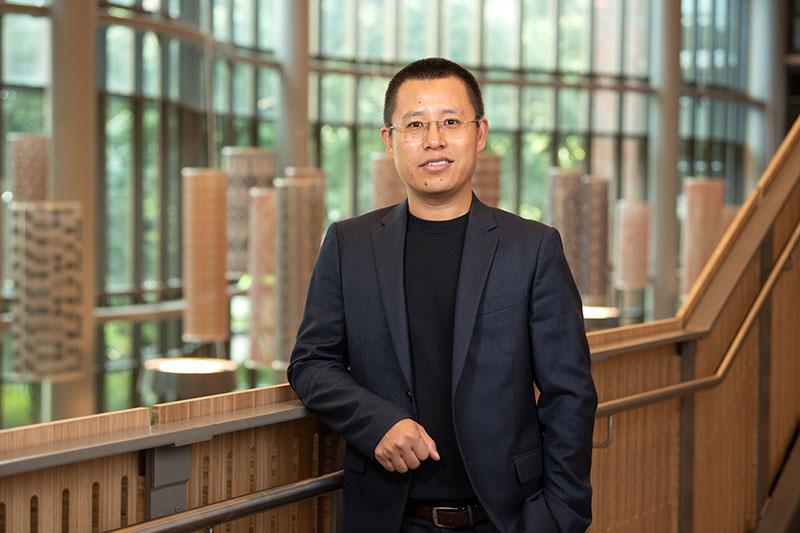
Shuhua Sun’s research career is marked by findings that challenge taken-for-granted assumptions and unsettle conventional understanding. Take his research on generative artificial intelligence, for example. Often promoted as a technology that promises automatic gains in productivity and creativity, Sun’s work shows that its effects are highly contingent, depending critically on how people engage with and manage the technology. As organizations race to integrate AI into daily operations, his research points to a clear implication: Competitive advantage will hinge less on access itself than on employees’ ability to use AI thoughtfully, strategically and reflectively.
“The underlying question I always have,” he says, “is how people and organizations can achieve goals. That’s the fundamental question I always try to answer in my research.” And so, while novel findings may dot the landscape of his work, it is his never-ending quest to understand how people pursue and achieve goals that emerges as a clear through line.
Under Pressure: What Makes People Succeed or Fail
Sun’s lifelong passion was ignited when, as an undergraduate, he first read the seminal book by the late psychologist Albert Bandura, Self-Efficacy: The Exercise of Control.
“Bandura has a strong point to make [in the book],” Sun explains, “and his point is that the reason we are humans is because we have goals. We are constantly striving to achieve something, and that striving is what gives our lives meaning. And I think that just resonates with me.”
It is not just the pursuit of goals by itself that fascinates Sun. In particular, it is the act of doing so while under significant pressure and how, despite that pressure (or perhaps because of it), people either fail or succeed. In addition, he looks for opportunities to study this in ways that are most relevant and impactful for society at any given time. This is what led him to research job searching and unemployment in the midst of the 2007-2008 financial crisis, during which many had lost their jobs and were seeking new employment amid an ailing economy. It is also what led him to research people working under the various pressures of new venture creation and the Covid-19 pandemic. And it is what led to his current research focus, the use of AI in organizations, a trend that is clearly driven in part by multiple forms of pressure.
Choosing the Right Goals and Knowing Yourself
One of the most surprising findings in Sun’s research is that despite the popular rhetoric in the media, integrating AI in the workplace at scale does not, in and of itself, necessarily lead to greater creativity, productivity and innovation. Rather, there are two primary factors that determine whether or not workplace AI use does in fact boost workers’ creativity. Moreover, at the deepest level, these factors are essentially the same core factors that increase the likelihood of success in goal pursuit overall.
The first factor is choosing the right goals.
“When you work for an organization, you have to solve certain problems,” Sun says, “but your ability to define the right problems to solve, sometimes, is more fundamental than the effort you spend to solve a problem.”
“Take AI, for example,” he continues. “Almost all the companies I talk to have strong motivation to deploy AI in the workplace. Some organizations even set a quota for their employees to use AI. So you have to use AI this number of times for it to be considered acceptable. But that creates stress for the employees, and it also leads to superficial or ineffective use of artificial intelligence. The consequences are not good for the organization.”
Sun’s research suggests that the correct goal, if organizations want to use AI to improve creativity and productivity, is not to meet a specific quota of usage but to help employees use AI strategically and effectively. That would be the correct goal in this particular situation.
But in order to choose the right goals, one must know how to even do so in the first place. This is where the second factor for success in goal pursuit comes in: metacognition.
“The basic idea of metacognition is to know yourself, your strengths, your weaknesses, and adjust accordingly,” he explains. “So before you do anything, you have to ask: Do I truly understand this task? What needs to be done in order to complete this task? Do I have those skills? What are my strengths? If I do not have those skills, where can I find help?”
With regards to AI, if an organization’s overarching objective is to improve creativity and productivity, then that organization’s leaders need to pause before starting anything and ask themselves if they truly understand the objective and whether or not getting employees to simply meet a quota of AI use is or is not the right goal to set.
Across many studies of different contexts, Sun’s research shows that knowing how to choose the correct goals in a given situation depends on this kind of deep analysis and self-awareness.
Helping People to Develop Metacognition
Integrating the insights of his research into the classroom is an important part of Sun’s teaching. And when it comes to the topic of metacognition in particular, there is a great need for students to learn about it given the widespread misconceptions that people have about themselves.
“Usually, people have this idea that they know themselves well,” Sun observes. “Well, actually, we don’t.”
This is why Sun devotes a considerable portion of his graduate course Managing People in Organizations to first and foremost managing one’s own self.
“The first session is called Managing Yourself,” he explains. “Before you can manage other people in organizations, you have to be able to manage yourself, which means, again, going back to the point about metacognition.”
Given the complexities and nuances of metacognition, it’s not a skill that can truly be developed through abstraction alone, which is one reason why Sun makes his course highly interactive.
“During my lectures I pose many questions,” Sun notes. “Students must think along with me to answer those questions. They need to monitor their reasoning, their decision-making and their assumptions. Over time, that process helps them understand how they actually think, not how they imagine they think. That’s part of the course design.”
Another important business trait that Sun tries to cultivate among his students is an international perspective. This comes from being born and raised in China, doing his doctoral study in Singapore (itself a very international country), and then moving to the Netherlands to teach at Maastricht University, where many of his students were international. Now, after a decade of living and teaching in the U.S. at Tulane University’s Freeman School of Business, he brings that intercultural knowledge and awareness to both his research and teaching. He also serves as Director of Asia Pacific Programs at the Goldring Institute for International Business, housed within the Freeman School of Business, a service role that he would like to be part of his overall impact at Tulane aside from his research and teaching.
When asked about the one thing he most wants his students to always remember, Sun nods and smiles in a way that suggests the answer should already be obvious.
“Know yourself,” he says without hesitation. “Know yourself.”
Indeed, that simple phrase captures the essence of Sun’s work at the Freeman School of Business. And it is a lesson that applies not just to his current students but to the future business leaders and decision makers they will surely become by applying that insight into practice.
Interested in advancing your education and/or career? Learn more about Freeman’s wide range of graduate and undergraduate programs. Find the right program for you.
Recommended Reading
- The Importance of AI Integration for Business Leaders
- Online vs. In-Person MBA: Benefits and Differences
- How to Develop a Global Mindset in Business
- How to Get Started in Sustainable Finance
- How to Improve Your Business Negotiation Skills
- How Is Data Analytics Used in Health Care?
- Supply Chain Analyst: Salary and Job Description
- Renewable Energy Consultant: Salary and Job Description
Other Related Articles
- What crowdfunding reveals about equity appeals
- Research Notes: Larisa Cioaca
- Beta Gamma Sigma recognizes newest members
- Seattle Times: Microsoft offers buyouts for longtime employees
- Forbes: How To Gain Influence In Meetings Through Executive Presence
- Making the case for civil discourse
- AP News: Simple ways to make meetings work better for employees on the autism spectrum
- Business Insider: The sneaky truth about the wave of AI layoffs
