
Alum helps make worldwide commerce happen
If you’ve ever made a purchase online, chances are that transaction was facilitated by software company SAP’s Enterprise Resource Planning (ERP) program, a massive and complex system used by governments and the world’s largest retail corporations. About 77% of the world’s transaction revenue passes through SAP software, and more than 425,000 companies across 180 countries use it to streamline daily operations.
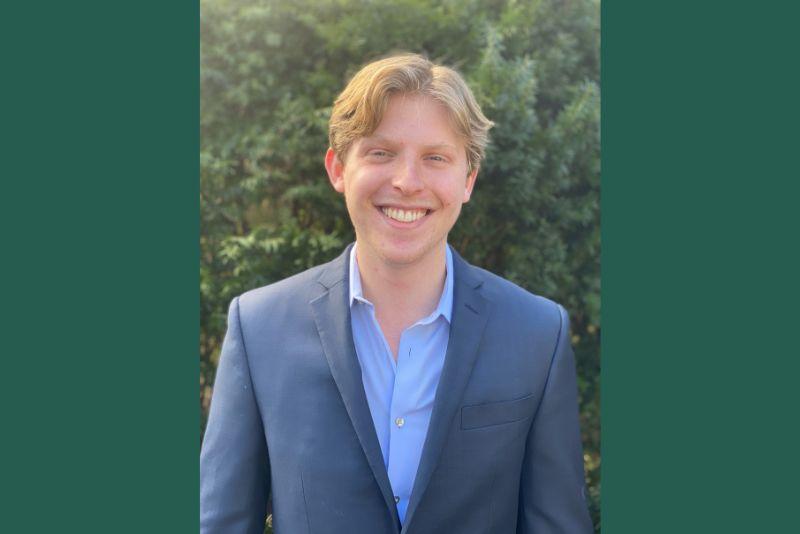
After nearly four years working as a technology consultant at EY, where he specializes in SAP, Noah Ehren (BSM ’21, MANA ’22) says he’s barely scratched the surface of the software’s capabilities. According to Ehren, the software’s scale — what it can do and the number of companies that use it — can’t be understated.
“Functionally, it’s incredibly complex, and you never really master it,” he says. “The software is the brain of a company’s operations, integrating tools for accounting, HR, inventory, procurement, logistics and more into a single system working in real time. It’s so complex that clients bring in tech consultants like me and my team, and we work on different aspects of the ERP for them.
“Right now, I’m working with a $5 billion revenue client,” he says. “Bringing their entire enterprise onto SAP will take at least five years.”
These lengthy, large-scale projects energize Ehren, who knows that winning big clients with big objectives is part of the job.
“It’s a competitive environment,” he says. “The Big Four consulting firms are all fighting for SAP implementation contracts so they can work with the biggest companies in the world.”
A significant portion of Ehren’s job involves digging into these companies so he can understand what they need the software to do.
“The client might not even know what they need at first,” he says. “It’s our job to talk with them, ask the right questions, figure out what the system needs to do and then fill in the gaps.
“Once we understand what the client needs their system to do, we build it. That process might involve configurations in the system itself and it might also involve coding and development work. Most of the development work is outsourced, but as a technology consultant, I have to be able to describe the target functionality to developers and make sure they have the information they need to build out a customization for a client.”
Next comes extensive testing, soft launches offline and final tweaks. Once Ehren’s team has verified that the client’s specifications are running seamlessly, they bring the software to life by initiating real-world transactions.
“The transition of the software from the test environment to the production or real-life environment is the best and worst part of any project,” Ehren says. “Months, even years of work all get put to the test. Emotions are high and hours are long. But that makes it all more satisfying when the go-live is a success.”
Today, Ehren is thoroughly steeped in the world of tech consulting, but as an undergraduate at Freeman, he was unsure where his career would take him.
“I was kind of lost in terms of what I wanted to do,” he says. “Then as I got towards the end of senior year, I landed on consulting and discovered that the best bet for me to break into that was to continue my education and get a master's.”
Ehren, who is originally from Long Island, obtained his Master of Business Analytics through the Freeman School’s 4+1 program, which enables undergraduate students to earn a graduate degree with one additional year of study. Now, he is helping today’s Freeman students make sense of their careers. Once a semester, he volunteers to speak with Professor of Practice Carmelo Turillo’s strategic consulting classes, keying them into the world of consulting and enterprise technology.
“I had no idea what I was getting myself into when I started my job,” he says. “I would have liked to have had an understanding of what the world of tech consulting looks like, so I’m trying to provide students with that kind of information.”
In his discussions, Ehren provides an overview of technology consulting, SAP, and an SAP project’s life cycle. He also gives students an inside look into the consultant lifestyle.
“My advice to students is to understand what consulting is like,” he says. “At first, my job was pretty chill. And then it was never chill. But I prefer it this way. I like the fast pace, and I like that you’re never stagnant for more than a week or two.”
Ehren spends about 50% of his time traveling to meet with clients and collaborate with colleagues. For all the hassle hotel living can entail, he says he has lots of fond memories from working so closely with his co-workers.
“I’m a social person, and this is a very social job,” he says. “I’m on a team with 30 people and we all meet every week in person. I appreciate that camaraderie.”
And the best part?
“It’s never the same thing twice. You’re always learning and always growing in tech consulting.”
Interested in advancing your education and/or career? Learn more about Freeman’s Specialized Master’s programs. Find the right program for you.
Recommended Reading
- The Importance of AI Integration for Business Leaders
- How Is Data Analytics Used in Health Care?
- Supply Chain Analyst: Salary and Job Description
- How Is AI Used in Retail Analytics?
- Business Analytics vs. Finance: Which Master’s Degree Is Right for You?
- What Skills Can You Gain From a Master of Business Analytics and AI Curriculum?
- Should I Enroll in a Specialized Master's Program?
- How to Become a Business Analyst
Other Related Articles
- MME students work with California energy producer to chart a profitable path to a carbon neutral future
- Students help launch the next generation of dorm décor
- Beta Gamma Sigma recognizes newest members
- Evacuation app earns top prize in inaugural Freeman AI Innovation Challenge
- The executive behind some of Hollywood’s biggest soundtracks
- Freeman makes big gains in latest U.S. News & World Report rankings
- Freeman rises to No. 30 in Poets&Quants’ Best Undergraduate Business Schools
- Green Bull puts students on track for investment banking success
